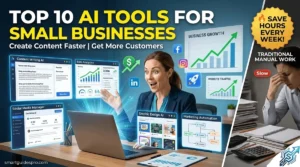
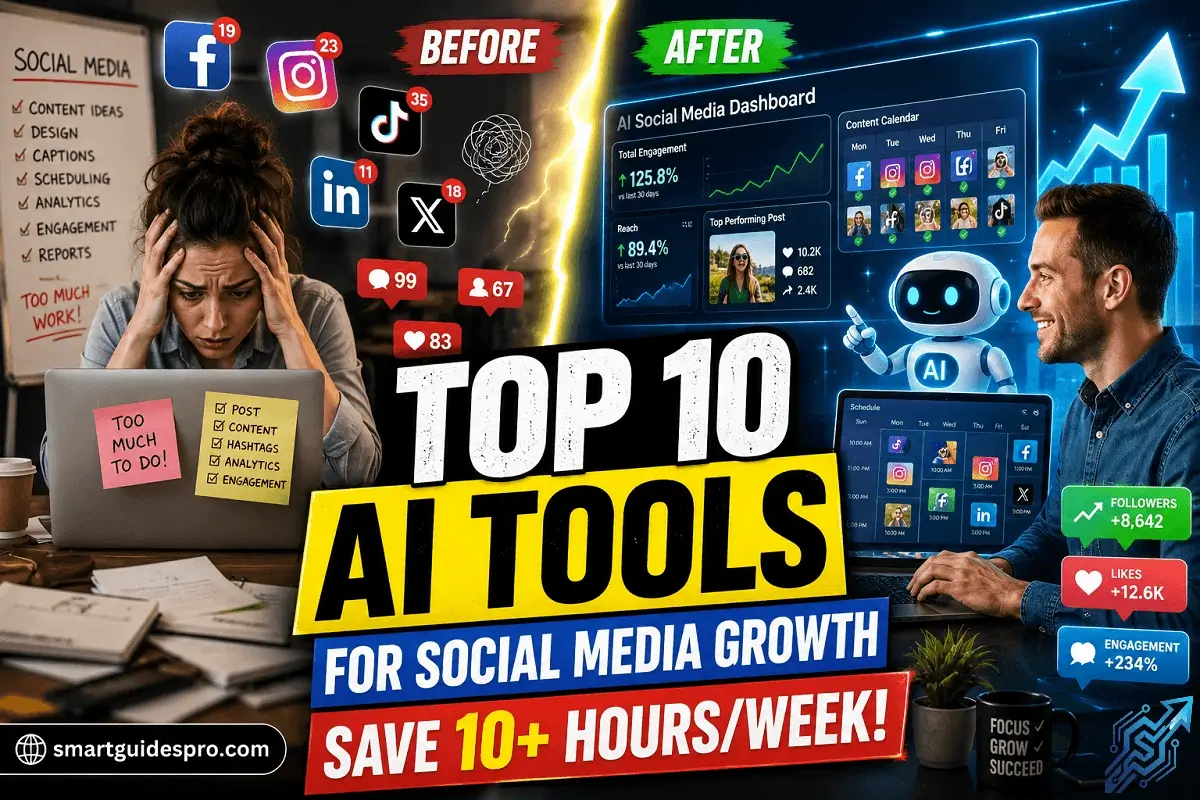
Top 10 Best AI Tools for Social Media Management for Small Businesses

Looking for the best AI tools for social media management? Discover the top AI-powered platforms that help small businesses create content faster, automate scheduling, improve engagement, track performance, and save hours every week. Compare the best AI social media tools, learn their pros and cons, and find the right solution to grow your social media presence more efficiently.
Introduction: Why AI Tools Are Changing Social Media Management for Small Businesses
Imagine trying to run a business while also creating daily content, writing captions, replying to comments, scheduling posts, tracking analytics, and keeping up with constantly changing social media trends. For many small business owners, that’s the reality.
The problem is simple: there are only so many hours in a day.
This is exactly why AI tools for social media management have become one of the most valuable resources for small businesses. Instead of spending hours on repetitive tasks, business owners can now use artificial intelligence to streamline content creation, automate scheduling, and gain insights that would normally require a dedicated marketing team.
Based on what I’ve seen, one of the biggest challenges for small businesses isn’t creativity—it’s consistency. Most business owners know they should post regularly, but finding the time to do it consistently can be difficult. A busy week can quickly turn into a month of inactivity on social media.
AI helps solve this problem.
Modern ai social media tools can generate content ideas, suggest captions, create posting schedules, and even recommend the best times to publish content. Some platforms can analyze audience behavior and provide suggestions that help increase engagement without requiring advanced marketing knowledge.
What surprised me most is how accessible these tools have become. A few years ago, advanced automation and analytics were typically reserved for large corporations with significant marketing budgets. Today, many affordable platforms offer powerful AI features specifically designed for entrepreneurs, freelancers, local businesses, and startups.
Another major advantage is speed.
Let’s say you’re promoting a new product. Instead of spending hours brainstorming captions for Facebook, Instagram, LinkedIn, and X, AI can generate multiple variations within minutes. Rather than manually posting across different platforms, many social media management tools allow you to schedule everything in advance from a single dashboard.
This efficiency gives small business owners more time to focus on activities that directly impact growth, such as serving customers, improving products, and building relationships.
AI is also improving decision-making. Many business owners rely on guesswork when planning content. However, modern ai tools for marketing can identify which posts perform best, what content your audience prefers, and where your engagement opportunities exist. These insights help businesses make smarter marketing decisions based on data rather than assumptions.
Of course, AI isn’t a replacement for human creativity or authentic communication. Customers still want to interact with real people and real brands. The most successful businesses use AI as an assistant, not a substitute. AI handles repetitive tasks while business owners focus on storytelling, customer relationships, and brand personality.
As social media becomes increasingly competitive, businesses that learn how to leverage ai tools for small businesses will likely have a significant advantage. The ability to create content faster, stay consistent, and make data-driven decisions can help even the smallest brands compete more effectively in crowded markets.
That’s why choosing the right AI-powered platform matters. In the next section, we’ll explore the best tools available today and what makes each one unique.
Related Articles:
Top 17 Best AI Tools for Small Businesses and Beginners (Complete Guide)
Top 10 Best AI Tools for Content Creation and marketing for Small businesses
Top 7 Best AI Tools for Business Automation and Workflow Management
Top 8 Best AI Tools for Productivity and Task Management for Small Businesses
10 Best Free AI Tools for Beginners (Guide for USA Student)
Top 10 Best AI Project Management Tools to Help Small Businesses Work Smarter
Top 7 AI Accounting and Bookkeeping Tools Small Businesses Should Know
Why Use AI Tools for Social Media Management?
Have you ever felt like social media marketing takes more time than it should?
You’re not alone. Many small business owners know that social media is important, but keeping up with content creation, scheduling, engagement, and analytics can quickly become overwhelming. When you’re already handling customers, operations, and sales, spending several hours a day on social media simply isn’t realistic.
This is one of the biggest reasons why AI tools for social media management have become increasingly popular among small businesses.
Instead of doing everything manually, AI can help automate repetitive tasks, speed up content creation, and provide valuable insights that help businesses make smarter marketing decisions. The goal isn’t to replace human creativity—it’s to help business owners work more efficiently.
AI Helps You Save Time on Repetitive Tasks
One of the most obvious benefits of AI is time savings.
Tasks like writing captions, scheduling posts, researching hashtags, and planning content calendars can consume hours every week. Many modern ai social media tools can automate these processes, allowing you to focus on growing your business rather than managing every social media detail manually.
For example, instead of creating posts one at a time, AI-powered platforms can generate multiple content ideas and schedule them across several social networks in a single workflow.
AI Makes Content Creation Easier
Coming up with fresh content consistently is often one of the hardest parts of social media management.
Many small businesses eventually run out of ideas or struggle to maintain a regular posting schedule. AI can help generate caption ideas, content outlines, post variations, and even image suggestions based on your industry and audience.
Based on experience, having a tool that can instantly generate content ideas significantly reduces the stress of staring at a blank screen wondering what to post next.
AI Improves Posting Consistency
Consistency is one of the most important factors in social media success.
Unfortunately, it’s also one of the first things to suffer when business owners get busy. Missed posting days can quickly turn into inactive weeks, which may reduce engagement and visibility.
Many social media management tools use AI to create automated publishing schedules, ensuring that content continues to be posted even during busy periods. This helps maintain a professional and active online presence without requiring constant manual effort.
AI Provides Data-Driven Insights
Successful social media marketing isn’t just about posting content—it’s about understanding what works.
AI-powered analytics tools can identify trends, highlight top-performing posts, track engagement patterns, and suggest improvements. Instead of relying on guesswork, businesses can make decisions based on real audience behavior.
From what I’ve seen, this is where AI often delivers the most value. Small businesses that pay attention to performance data tend to improve their content strategy much faster than those relying solely on intuition.
AI Helps Small Businesses Compete More Effectively
Large brands often have dedicated marketing teams, designers, content creators, and analysts. Small businesses typically don’t have those resources.
This is where ai tools for marketing can level the playing field.
With the right AI tools, a solo entrepreneur or small team can produce professional-quality content, automate routine tasks, and analyze campaign performance without hiring additional staff. This allows smaller businesses to compete more effectively, even with limited budgets.
The Real Goal Is Working Smarter, Not Harder
What surprised me most about AI-powered social media tools is that their biggest benefit isn’t necessarily automation—it’s efficiency.
AI doesn’t replace your brand voice, customer relationships, or creativity. Instead, it removes many of the repetitive tasks that consume valuable time. This allows business owners to focus on building genuine connections with their audience while AI handles much of the background work.
As social media continues to evolve, businesses that learn how to leverage ai tools for small businesses can often achieve better results with less effort. The key is choosing tools that support your goals rather than trying to automate everything.
Related Articles:
Key Benefits of Using AI Tools for Social Media Management
What if you could spend less time managing social media while achieving better results?
That’s exactly why more small businesses are turning to AI tools for social media management. While the idea of using AI may sound complex at first, the actual benefits are surprisingly practical. Whether you’re running a local business, an online store, or a growing startup, AI can help simplify your workflow and make social media marketing more manageable.
The best part is that many of these benefits don’t require advanced technical skills. Modern AI platforms are designed to help business owners save time, stay organized, and make smarter marketing decisions without needing a full marketing team.
Here are some of the biggest advantages of using AI for social media management.
1. Save Hours Every Week
Time is one of the most valuable resources for any small business owner.
Creating content, writing captions, scheduling posts, researching hashtags, and monitoring engagement can easily take several hours each week. AI automates many of these repetitive tasks, allowing you to accomplish more in less time.
For example, instead of manually creating a month’s worth of social media content, AI can generate ideas, draft captions, and help organize your publishing schedule within minutes.
Based on experience, this time-saving benefit alone often makes AI tools worth the investment.
2. Maintain Consistent Posting Schedules
Consistency is one of the biggest factors behind successful social media accounts.
Unfortunately, many businesses post regularly for a few weeks and then disappear when things get busy. This inconsistency can reduce engagement and make it harder to build an active audience.
Many social media management tools use AI-powered scheduling features that help maintain a steady posting calendar. Content can be planned and scheduled in advance, ensuring your audience continues to see regular updates even during busy periods.
3. Generate Content Ideas Faster
Running out of content ideas is a common challenge.
After months of posting, many business owners find themselves repeating the same topics or struggling to think of something new. AI can analyze trends, generate post ideas, suggest content themes, and even create multiple caption variations.
One thing I’ve noticed is that AI often works best as a brainstorming partner. Even if you don’t use every suggestion, it can spark ideas that help keep your content fresh and engaging.
4. Improve Content Quality
Creating social media content isn’t just about posting frequently—it’s about creating content that people actually want to engage with.
Many ai social media tools can suggest stronger headlines, improve captions, recommend hashtags, and optimize content for specific platforms. Some tools can even analyze previous performance and recommend formats that are more likely to generate engagement.
This can be especially valuable for small businesses that don’t have dedicated content writers or social media specialists.
5. Make Better Decisions with Analytics
Without data, social media marketing often becomes a guessing game.
AI-powered analytics tools can track engagement rates, audience behavior, click-through rates, and content performance. More importantly, they can help identify patterns that may not be obvious at first glance.
For example, AI may reveal that your audience engages more with educational posts than promotional content, or that certain posting times consistently generate better results.
These insights help businesses improve their strategy based on evidence rather than assumptions.
6. Reduce Marketing Costs
Hiring content creators, social media managers, designers, and analysts can be expensive, especially for smaller businesses.
While AI isn’t a complete replacement for marketing professionals, it can significantly reduce the workload associated with many routine tasks. This allows businesses to accomplish more without dramatically increasing their marketing budget.
For startups and entrepreneurs working with limited resources, this can provide a substantial advantage.
7. Manage Multiple Platforms More Efficiently
Most businesses no longer rely on a single social network.
Managing Facebook, Instagram, LinkedIn, X, TikTok, and Pinterest separately can quickly become overwhelming. Many ai tools for marketing centralize these activities into a single dashboard, making it easier to create, schedule, and monitor content across multiple platforms.
Instead of switching between several apps throughout the day, you can manage everything from one place.
Quick Summary of the Main Benefits
| Benefit | Why It Matters |
| Time Savings | Reduces repetitive manual work |
| Consistency | Keeps posting schedules active |
| Content Creation | Generates ideas and captions faster |
| Better Quality | Improves messaging and engagement |
| Analytics | Provides actionable insights |
| Cost Efficiency | Reduces the need for additional resources |
| Multi-Platform Management | Simplifies social media workflows |
Ultimately, the biggest advantage of ai tools for small businesses is that they help business owners focus on strategy rather than routine tasks. Instead of spending hours managing every aspect of social media, you can invest more time in serving customers, growing your brand, and building meaningful relationships with your audience.
Related Articles:
Top 10 Best AI Tools for Social Media Management for Small Businesses
With so many platforms claiming to be the ultimate social media solution, how do you know which ones are actually worth your time and money?
The truth is that not every tool is built for small businesses. Some are designed for large enterprises with complex workflows, while others focus on simplicity, affordability, and automation. The best AI tools for social media management help you save time, create better content, schedule posts efficiently, and understand what’s working without requiring a huge marketing budget.
Based on what I’ve seen, the most effective tools are the ones that combine automation with ease of use. Small business owners need solutions that simplify their workflow rather than add more complexity.
Below are ten of the best ai social media tools available today for content creation, scheduling, analytics, and overall social media management.
1. Buffer
Best For: Beginners and small businesses looking for a simple scheduling platform.
Buffer has earned a strong reputation for being easy to use while still offering powerful scheduling and content planning features. Its AI Assistant helps generate captions, rewrite content, and brainstorm post ideas.
Pros:
- User-friendly interface
- AI caption generation
- Affordable pricing
- Supports multiple social platforms
Cons:
- Limited advanced analytics
- Fewer automation features than some competitors
Ideal For:
Small businesses, freelancers, and startups that want a straightforward social media management solution.
Official Website: https://buffer.com
2. Hootsuite
Best For: Businesses managing multiple social media accounts.
Hootsuite is one of the most established social media management tools on the market. Its AI-powered features help with content creation, scheduling, social listening, and performance tracking.
Pros:
- Comprehensive dashboard
- Strong analytics
- Social listening capabilities
- Team collaboration features
Cons:
- Higher pricing compared to some alternatives
- Learning curve for beginners
Ideal For:
Growing businesses managing several social channels simultaneously.
Official Website: https://www.hootsuite.com
3. Sprout Social
Best For: Advanced analytics and audience insights.
Sprout Social combines AI-driven reporting with powerful engagement tools. It helps businesses understand audience behavior and optimize content strategies.
Pros:
- Excellent reporting features
- Advanced analytics
- Smart inbox for engagement management
- Strong customer support
Cons:
- Premium pricing
- More features than some small businesses may need
Ideal For:
Businesses focused on data-driven marketing decisions.
Official Website: https://sproutsocial.com
4. SocialBee
Best For: Content categorization and evergreen content management.
SocialBee helps businesses organize content into categories and automatically recycle evergreen posts. Its AI assistant also supports content generation and optimization.
Pros:
- AI content creation
- Evergreen posting features
- Content categorization system
- Easy scheduling
Cons:
- Analytics are less robust than premium competitors
- Interface may feel busy initially
Ideal For:
Businesses that frequently repurpose content.
Official Website: https://socialbee.com
5. Metricool
Best For: Affordable analytics and scheduling.
Metricool combines scheduling, analytics, and ad tracking in a single platform. It offers excellent value for small businesses working with limited budgets.
Pros:
- Affordable plans
- Strong reporting tools
- Multi-platform scheduling
- Ad performance tracking
Cons:
- AI capabilities are less advanced than some competitors
- Limited content creation features
Ideal For:
Budget-conscious small businesses.
Official Website: https://metricool.com
6. Ocoya
Best For: AI-powered content creation.
Ocoya focuses heavily on content generation and design. It can create captions, social media posts, and marketing content using AI while integrating scheduling capabilities.
Pros:
- AI content generation
- Built-in design tools
- E-commerce integrations
- Fast content creation workflow
Cons:
- Analytics are not its strongest feature
- Some advanced features require higher-tier plans
Ideal For:
Businesses creating large volumes of social content.
Official Website: https://www.ocoya.com
7. Predis.ai
Best For: AI-generated social media posts and creatives.
Predis.ai automatically creates captions, graphics, and content suggestions based on your business niche.
Pros:
- AI-generated visuals
- Competitor analysis features
- Caption and hashtag generation
- Easy content planning
Cons:
- Creative output may require editing
- Limited advanced analytics
Ideal For:
Businesses looking to speed up content production.
Official Website: https://predis.ai
8. Later
Best For: Instagram-focused businesses.
Later started as an Instagram scheduling tool but has evolved into a comprehensive social media management platform with AI-powered content assistance.
Pros:
- Visual content calendar
- Strong Instagram features
- User-friendly interface
- AI caption support
Cons:
- Analytics are less detailed than enterprise tools
- Best features focus on visual platforms
Ideal For:
Brands relying heavily on Instagram and visual content.
Official Website: https://later.com
9. Canva
Best For: Creating social media graphics with AI assistance.
Although primarily known as a design platform, Canva has become one of the most useful ai tools for marketing thanks to its AI-powered content generation and design features.
Pros:
- Beginner-friendly design tools
- AI image generation
- Thousands of templates
- Strong collaboration features
Cons:
- Not a full social media management platform
- Limited analytics capabilities
Ideal For:
Businesses that need professional-looking visuals quickly.
Official Website: https://www.canva.com
10. Publer
Best For: Affordable all-in-one scheduling.
Publer offers AI writing assistance, post scheduling, analytics, and content recycling at a competitive price point.
Pros:
- Cost-effective pricing
- AI caption generation
- Bulk scheduling
- Post recycling features
Cons:
- Smaller ecosystem compared to major competitors
- Advanced analytics are somewhat limited
Ideal For:
Small businesses seeking an affordable all-in-one solution.
Official Website: https://publer.io
Quick Overview of the Top Tools
| Tool | Best For | AI Features | Free Plan |
| Buffer | Beginners | Caption generation | Yes |
| Hootsuite | Multi-platform management | Content assistance, analytics | Limited |
| Sprout Social | Analytics | Audience insights | No |
| SocialBee | Evergreen content | AI content generation | Trial |
| Metricool | Budget users | Analytics assistance | Yes |
| Ocoya | Content creation | AI writing and design | Trial |
| Predis.ai | Automated content | AI creatives | Yes |
| Later | Instagram marketing | Caption assistance | Yes |
| Canva | Visual content | AI design tools | Yes |
| Publer | Affordable scheduling | AI writing | Yes |
Each of these ai tools for small businesses offers something different. Some focus on content creation, while others excel in analytics, scheduling, or design. The best choice depends on your goals, budget, and the platforms you use most frequently.
In the next section, we’ll compare these tools side by side to help you identify which option may be the best fit for your business.
Related Articles:
How to Use AI Tools for Social Media Management Effectively
Simply having access to AI doesn’t guarantee better social media results.
One mistake I’ve noticed is that many business owners sign up for powerful tools, generate a few AI-written posts, and expect immediate growth. When that doesn’t happen, they assume the tool doesn’t work. In reality, the most successful businesses use AI tools for social media management as part of a clear strategy rather than relying on automation alone.
AI can save time, improve consistency, and simplify content creation, but it works best when guided by human creativity and business goals.
So how can you get the most value from these tools?
Start With a Clear Content Strategy
Before using any AI platform, define what you want your social media accounts to achieve.
Ask yourself:
- Do you want more brand awareness?
- Are you trying to generate leads?
- Do you want to increase website traffic?
- Are you focused on customer engagement?
- Do you want more product sales?
The answers will help determine the type of content you create and how you use AI to support your goals.
For example, a local coffee shop may focus on community engagement and promotions, while an online software company may prioritize educational content and lead generation.
AI works much better when it has a clear direction.
Use AI for Content Ideation, Not Just Content Generation
Many ai social media tools can instantly generate captions and posts, but their greatest value often comes from idea generation.
Instead of copying AI output word for word, use it to:
- Brainstorm content topics
- Create post outlines
- Generate headline variations
- Develop campaign ideas
- Discover new content angles
Based on experience, the best-performing content usually combines AI efficiency with personal insights and real-world expertise.
Create Content in Batches
One of the easiest ways to save time is by batch-creating content.
Rather than creating posts every day, dedicate one or two sessions each month to planning and producing content. AI can help generate captions, suggest hashtags, and organize posts much faster than manual workflows.
A simple process might look like this:
- Generate content ideas with AI.
- Select the best topics.
- Customize captions with your brand voice.
- Design visuals.
- Schedule content for the coming weeks.
This approach can significantly reduce daily marketing stress.
Always Personalize AI-Generated Content
AI-generated content should rarely be published without review.
Your audience follows your business because of your unique experience, expertise, and personality. While AI can create a solid first draft, adding personal insights helps content feel more authentic and trustworthy.
For example, consider adding:
- Customer stories
- Personal observations
- Industry experiences
- Behind-the-scenes insights
- Real business lessons
From what I’ve seen, audiences respond much better to content that feels human rather than overly automated.
Use Scheduling Features to Stay Consistent
Consistency is one of the biggest factors behind social media success.
Many social media management tools include AI-assisted scheduling that recommends optimal posting times based on audience behavior.
Instead of posting randomly, create a publishing calendar and schedule content in advance. This helps maintain a consistent presence even during busy periods.
A simple posting schedule might include:
| Content Type | Frequency |
| Educational Posts | 2–3 times per week |
| Promotional Content | 1–2 times per week |
| Customer Stories | 1 time per week |
| Behind-the-Scenes Content | 1 time per week |
| Industry Tips | 2 times per week |
Consistency often matters more than posting volume.
Monitor Performance and Let Data Guide Decisions
One of the biggest advantages of modern ai tools for marketing is access to analytics.
Instead of guessing what works, review metrics such as:
- Engagement rate
- Reach
- Click-through rate
- Follower growth
- Website traffic
- Conversion performance
AI can help identify patterns and trends that may not be obvious at first glance.
For example, you may discover that short educational videos consistently outperform promotional graphics, allowing you to adjust your strategy accordingly.
Avoid Over-Automating Everything
Automation is helpful, but too much automation can make a brand feel impersonal.
Customers still expect genuine interactions, especially when they leave comments or send direct messages. AI should assist communication, not completely replace it.
In my opinion, the ideal balance is:
- Let AI handle repetitive tasks.
- Let humans handle relationships and brand personality.
This approach preserves authenticity while still benefiting from AI-driven efficiency.
A Simple Framework for Using AI Successfully
If you’re new to AI-powered social media management, remember this simple framework:
Plan → Create → Personalize → Schedule → Analyze → Improve
Businesses that follow this cycle consistently tend to get the most value from ai tools for small businesses. AI isn’t a magic solution, but when combined with a clear strategy and authentic communication, it can dramatically improve productivity and help businesses build a stronger social media presence over time.
Related Articles:
Real Examples: How Small Businesses Use AI Tools to Manage Social Media Faster
It’s easy to talk about AI in theory, but what does it actually look like in the real world?
Many small business owners understand the potential benefits of AI tools for social media management, yet they often struggle to picture how these tools fit into their daily workflow. The good news is that AI doesn’t require a complete overhaul of your marketing strategy. In most cases, businesses simply use AI to speed up tasks they are already doing.
Below are several realistic examples of how small businesses are using AI to save time, stay consistent, and improve their social media marketing efforts.
Example 1: A Local Coffee Shop Creates Weekly Content in One Hour
Imagine a neighborhood coffee shop that posts on Instagram and Facebook.
Before using AI, the owner spent several hours each week brainstorming post ideas, writing captions, and planning promotions. Some weeks, social media was simply ignored because other business priorities took over.
After adopting one of the popular ai social media tools, the owner began using AI to:
- Generate content ideas for the month
- Create caption drafts
- Suggest seasonal promotions
- Schedule posts in advance
Instead of spending 4–5 hours per week on content planning, the entire process could be completed in about an hour. The result was a more consistent posting schedule and a stronger online presence.
Example 2: An Online Boutique Automates Product Promotion
Small e-commerce businesses often launch new products regularly, which means constantly creating fresh promotional content.
An online clothing boutique can use AI to:
- Generate product descriptions
- Create social media captions
- Suggest hashtags
- Repurpose product content across multiple platforms
For example, a single product description can be transformed into:
- An Instagram caption
- A Facebook post
- A Pinterest description
- A LinkedIn update
- A short promotional tweet
This allows the business to maximize content output without creating everything from scratch.
Example 3: A Real Estate Agent Uses AI for Content Ideas
Real estate professionals often need to maintain visibility online while managing clients and property showings.
One thing I’ve noticed is that many agents struggle with consistency because they simply run out of content ideas.
Using AI tools for marketing, a real estate agent can quickly generate topics such as:
- Home-buying tips
- Market updates
- Neighborhood highlights
- Property staging advice
- Frequently asked questions
Instead of wondering what to post each day, they can maintain a content calendar filled with relevant and useful information for potential clients.
Example 4: A Fitness Coach Schedules an Entire Month of Content
Fitness coaches and personal trainers often spend most of their time working directly with clients.
AI helps by:
- Creating workout tips
- Generating motivational captions
- Suggesting content themes
- Organizing posting schedules
Based on experience, batching content is one of the most effective ways to save time. A fitness coach can spend a few hours creating content for an entire month and then use scheduling tools to publish it automatically.
This allows more focus on coaching clients while maintaining an active social media presence.
Example 5: A Small Marketing Agency Improves Productivity
Even small agencies use AI to streamline operations.
Rather than manually creating every social media post, agencies often use AI to:
- Draft content outlines
- Generate caption variations
- Create content calendars
- Analyze engagement performance
The human team then reviews, edits, and personalizes the content before publishing.
This hybrid approach helps agencies serve more clients without sacrificing quality.
What These Examples Have in Common
Although these businesses operate in different industries, they all use AI in similar ways.
| Business Type | How AI Helps |
| Coffee Shop | Content planning and scheduling |
| Online Store | Product promotion and content repurposing |
| Real Estate Agent | Content ideation and consistency |
| Fitness Coach | Batch content creation |
| Marketing Agency | Workflow efficiency and productivity |
Notice that none of these examples rely on AI to do everything.
Instead, AI handles repetitive tasks while humans focus on creativity, customer relationships, and business expertise. This is often where the greatest value comes from.
The Biggest Lesson Small Businesses Can Learn
What surprised me most after seeing how businesses use AI is that the biggest gains usually come from simple improvements rather than advanced automation.
Most small businesses don’t need complicated systems. They simply need a way to:
- Create content faster
- Stay consistent
- Reduce manual work
- Make better marketing decisions
That’s exactly where modern social media management tools excel.
Whether you’re a local business owner, freelancer, consultant, or online entrepreneur, AI can help eliminate many of the repetitive tasks that make social media feel overwhelming. When used correctly, these tools don’t just save time—they create space to focus on what matters most: growing your business and serving your customers.
Related Articles:
My Experience Using AI Tools for Social Media Content and Scheduling
When I first started exploring AI tools for social media management, I was skeptical.
Like many people, I assumed AI-generated content would sound robotic, generic, and obvious. I also wondered whether these tools would actually save time or simply add another layer of complexity to an already busy workflow.
After spending time testing different platforms and observing how businesses use them, my perspective changed.
What surprised me most wasn’t the quality of the content itself—it was how much time AI could save during the planning and scheduling process.
The Biggest Challenge Was Never Writing
Before using AI, I assumed content creation was the most time-consuming part of social media marketing.
In reality, I found that the bigger challenge was everything surrounding content creation:
- Thinking of new ideas
- Organizing a content calendar
- Writing multiple versions of captions
- Adapting content for different platforms
- Scheduling posts consistently
Writing a single post might take only a few minutes, but planning an entire week or month of content often required significantly more effort.
This is where AI became genuinely useful.
AI Works Best as a Creative Assistant
One thing I’ve noticed is that AI performs best when used as a starting point rather than a final solution.
For example, if I needed ideas for a week’s worth of content, AI could quickly generate dozens of suggestions based on a topic or industry. Instead of staring at a blank screen, I suddenly had a list of potential angles to work with.
The same applied to captions.
Rather than writing everything from scratch, AI could create a draft that I could personalize and improve. In many cases, editing an AI-generated draft took less time than creating a completely new caption.
This simple shift dramatically sped up the content creation process.
Scheduling Became Much Easier
Another area where I saw immediate value was scheduling.
Many social media management tools combine AI assistance with scheduling features, making it possible to plan content weeks in advance.
Instead of logging into multiple platforms every day, I could:
- Create content in batches.
- Review and edit captions.
- Schedule posts across multiple channels.
- Monitor performance later.
Based on experience, batch scheduling is one of the most effective productivity strategies for social media marketing. It reduces daily interruptions and creates a more organized workflow.
AI Helped Reduce Content Fatigue
If you’ve managed social media for any length of time, you’ve probably experienced content fatigue.
After publishing dozens or hundreds of posts, it becomes harder to come up with fresh ideas.
This is where many ai social media tools shine.
AI can generate:
- Topic suggestions
- Content themes
- Seasonal ideas
- Frequently asked questions
- Educational post concepts
Even when I didn’t use the suggestions directly, they often sparked new ideas that I hadn’t considered before.
In my opinion, this brainstorming support is one of the most underrated benefits of AI-powered marketing tools.
The Results Weren’t Always Perfect
Of course, AI isn’t flawless.
Some generated captions felt repetitive. Others sounded overly promotional or lacked the personality that makes content feel authentic.
That’s why I would never recommend publishing AI-generated content without reviewing it first.
The best results came from combining AI efficiency with human judgment.
Typically, the process looked like this:
| Task | AI Role | Human Role |
|---|---|---|
| Content Ideas | Generate suggestions | Select the best ideas |
| Captions | Create drafts | Edit and personalize |
| Scheduling | Automate publishing | Approve content calendar |
| Analytics | Identify patterns | Make strategic decisions |
This balance allowed AI to handle repetitive work while keeping the content authentic.
What Delivered the Most Value?
If I had to choose the single biggest benefit, it would be consistency.
Many businesses struggle with social media not because they lack creativity, but because they lack time.
AI helped remove some of the barriers that often lead to inconsistent posting. By simplifying planning, content creation, and scheduling, it became much easier to maintain an active presence online.
From what I’ve seen, businesses that consistently publish valuable content tend to outperform those that post sporadically, even if the content itself isn’t perfect.
My Overall Take on AI Social Media Tools
After exploring various ai tools for marketing, I’ve come to view them as productivity tools rather than magic solutions.
They won’t instantly make content go viral.
They won’t replace creativity.
They won’t eliminate the need for strategy.
What they can do is help businesses create content faster, stay organized, reduce repetitive work, and maintain consistency across multiple platforms.
For most ai tools for small businesses, that’s already a significant advantage.
If you’re willing to review, edit, and personalize AI-generated content, these tools can become valuable assistants that help you spend less time managing social media and more time growing your business.
Related Articles:
Which AI Tools Are Actually Worth Using for Social Media Management?
After reviewing dozens of platforms, one question keeps coming up:
Which AI tools are actually worth using?
The answer depends on your goals.
Not every business needs the most advanced platform on the market. In fact, many small businesses end up paying for features they never use. Based on what I’ve seen, the best approach is to choose a tool that solves your biggest problem, whether that’s content creation, scheduling, analytics, design, or overall social media management.
If you’re a small business owner with limited time and budget, these are the tools I would prioritize first.
If You Want the Best Overall Social Media Management Tool
Recommended Tool: Buffer
Buffer remains one of the most balanced AI tools for social media management available today.
It combines ease of use, scheduling, content planning, and AI-powered caption assistance without overwhelming users with unnecessary complexity.
Why it’s worth using:
- Beginner-friendly interface
- Reliable scheduling features
- Affordable pricing
- AI content assistance
- Supports multiple social platforms
In my opinion, Buffer is one of the safest choices for most small businesses because it delivers strong value without requiring a steep learning curve.
If Content Creation Is Your Biggest Challenge
Recommended Tool: Ocoya
Many businesses struggle more with creating content than scheduling it.
Ocoya focuses heavily on AI-powered content generation, making it useful for businesses that need a steady stream of social media posts.
Why it’s worth using:
- AI-generated captions
- Content templates
- Built-in design tools
- Fast content creation workflow
If you’re constantly wondering what to post next, Ocoya can significantly reduce content planning time.
If You Need Better Analytics
Recommended Tool: Sprout Social
Some businesses already have a strong content strategy but lack visibility into what is actually working.
Sprout Social excels at analytics and reporting.
Why it’s worth using:
- Advanced audience insights
- Detailed engagement reports
- Performance tracking
- Data-driven recommendations
For businesses that make decisions based on metrics rather than assumptions, this platform offers tremendous value.
If You’re Looking for a Budget-Friendly Option
Recommended Tool: Metricool
Not every business can justify premium software subscriptions.
Metricool provides many essential features found in larger platforms at a more affordable price point.
Why it’s worth using:
- Affordable plans
- Scheduling tools
- Analytics dashboard
- Multi-platform management
For startups and entrepreneurs, it’s often one of the best entry points into AI-assisted social media management.
If Instagram Is Your Main Platform
Recommended Tool: Later
Businesses focused heavily on visual content often benefit from Later.
Its visual content calendar and Instagram-focused workflow make content planning much easier.
Why it’s worth using:
- Visual scheduling interface
- Instagram optimization
- AI caption assistance
- Content planning tools
From what I’ve seen, Later is particularly effective for brands, creators, and businesses that rely heavily on visual storytelling.
If Design Is Slowing You Down
Recommended Tool: Canva
While Canva isn’t a traditional social media management platform, it’s one of the most useful ai tools for marketing available today.
Its AI-powered design features allow businesses to create professional-looking content without hiring a designer.
Why it’s worth using:
- AI image generation
- Social media templates
- Easy drag-and-drop editor
- Fast content production
Many small businesses use Canva alongside scheduling platforms to create a complete workflow.
If You Need an Affordable All-in-One Solution
Recommended Tool: Publer
Publer combines scheduling, content management, and AI writing assistance into a single platform.
Why it’s worth using:
- Competitive pricing
- AI caption generation
- Bulk scheduling
- Content recycling features
For businesses seeking an all-in-one solution without enterprise-level pricing, Publer is worth considering.
My Personal Recommendations by Business Type
To make things easier, here’s a quick summary based on business needs.
| Business Need | Recommended Tool |
| Complete Social Media Management | Buffer |
| Content Creation | Ocoya |
| Analytics and Reporting | Sprout Social |
| Budget-Friendly Option | Metricool |
| Instagram Marketing | Later |
| Graphic Design | Canva |
| Affordable All-in-One Platform | Publer |
So, Which Tool Should Most Small Businesses Choose?
If I had to recommend just one platform for the average small business, I’d start with Buffer.
It offers the right balance of simplicity, functionality, and affordability while covering the core tasks most businesses need.
However, the “best” tool ultimately depends on your specific goals.
- Need content ideas? Choose Ocoya.
- Need deeper analytics? Choose Sprout Social.
- Need affordable scheduling? Choose Metricool.
- Need better visuals? Choose Canva.
- Need Instagram-focused features? Choose Later.
The good news is that most of these ai social media tools offer free plans or trial periods, allowing you to test them before making a long-term commitment.
Rather than chasing every new AI feature, focus on finding a tool that helps solve your biggest bottleneck. That’s usually where you’ll see the greatest improvement in productivity and results.
Related Articles:
Are AI Tools Really Helpful for Social Media Growth and Engagement?
With so much hype surrounding artificial intelligence, it’s fair to ask an important question:
Do AI tools actually help grow social media accounts, or are they just another marketing trend?
The short answer is yes, but probably not in the way many people expect.
One of the biggest misconceptions about AI tools for social media management is that they can automatically generate followers, boost engagement overnight, or make content go viral. In reality, AI doesn’t create success by itself. What it does is help businesses execute proven social media strategies more consistently and efficiently.
Based on what I’ve seen, the businesses that benefit most from AI are not necessarily the ones using the most advanced tools. They’re the ones using AI to stay organized, publish consistently, and make better decisions.
AI Improves Consistency, Which Supports Growth
If there’s one factor that repeatedly shows up in successful social media accounts, it’s consistency.
Unfortunately, consistency is often where small businesses struggle.
Many business owners start with good intentions, posting regularly for a few weeks before becoming too busy to keep up. As posting frequency decreases, engagement often follows.
AI helps solve this problem by simplifying content planning, scheduling, and creation.
For example, many social media management tools allow businesses to:
- Create content in batches
- Schedule posts weeks in advance
- Generate caption ideas quickly
- Maintain a structured content calendar
The result is a more consistent online presence, which can contribute to long-term audience growth.
AI Can Help Increase Engagement
Engagement is influenced by many factors, including content quality, audience relevance, timing, and consistency.
AI can assist with several of these areas.
Many ai social media tools analyze audience behavior and provide recommendations such as:
- Best posting times
- High-performing content formats
- Effective hashtag suggestions
- Engagement trends
- Content optimization ideas
These insights help businesses create content that is more likely to resonate with their audience.
However, AI cannot replace authentic communication.
People engage with content because it is useful, entertaining, relatable, or inspiring—not simply because it was created with AI.
AI Makes Content Production More Sustainable
One challenge that rarely gets discussed is sustainability.
Creating social media content every week for months or years can become exhausting. Many businesses eventually experience content burnout.
AI helps reduce this burden by assisting with:
- Content brainstorming
- Caption writing
- Topic generation
- Content repurposing
- Editorial planning
From what I’ve seen, businesses that reduce content fatigue are more likely to maintain long-term consistency, which often leads to stronger growth over time.
Where AI Delivers the Biggest Impact
The most valuable benefits often happen behind the scenes.
Instead of directly increasing followers, AI improves the systems that support growth.
| Area | How AI Helps |
| Content Planning | Generates ideas faster |
| Scheduling | Maintains posting consistency |
| Analytics | Identifies successful content |
| Productivity | Reduces manual workload |
| Optimization | Improves content performance |
| Content Repurposing | Extends the value of existing content |
This is why many businesses report improved social media performance after adopting AI-powered workflows.
The tools themselves are not generating growth—the improved processes are.
What AI Cannot Do
It’s equally important to understand AI’s limitations.
AI cannot:
- Guarantee viral content
- Replace genuine customer relationships
- Create a unique brand personality
- Understand your audience perfectly
- Build trust automatically
One thing I’ve noticed is that businesses often struggle when they rely too heavily on automation.
If every post sounds generic or robotic, engagement can actually decrease. Audiences still want authentic experiences and human perspectives.
That’s why the best-performing businesses use AI as an assistant rather than a replacement for creativity.
Realistic Expectations Lead to Better Results
In my opinion, the biggest mistake business owners make is expecting AI to solve every social media challenge.
A more realistic expectation is this:
AI helps you execute a good strategy more efficiently.
If your content strategy is already strong, AI can help you scale it.
If your posting schedule is inconsistent, AI can help you stay organized.
If you’re spending too much time on repetitive tasks, AI can improve productivity.
But if there’s no strategy in place, AI alone won’t create meaningful growth.
So, Are AI Tools Worth It?
For most small businesses, the answer is yes.
Modern ai tools for marketing can help save time, improve consistency, reduce content fatigue, and provide valuable insights that support better decision-making. These advantages often contribute to stronger engagement and more sustainable growth over time.
The key is understanding that AI is not a shortcut to success. Instead, it’s a tool that helps businesses work smarter and execute their social media strategy more effectively.
When used correctly, ai tools for small businesses can become valuable partners in building an active, engaging, and growing social media presence.
Related Articles:
Pros and Cons of Using AI Tools for Social Media Management
By now, it’s clear that AI tools for social media management can save time, improve efficiency, and help businesses stay consistent. But like any technology, AI isn’t perfect.
Before investing in any platform, it’s important to understand both the advantages and the limitations. Some business owners focus only on the benefits and overlook potential drawbacks, while others dismiss AI entirely because they expect it to be flawless.
The reality lies somewhere in the middle.
Based on what I’ve seen, businesses get the best results when they understand what AI does well and where human input is still essential.
The Pros of Using AI for Social Media Management
Let’s start with the biggest advantages.
1. Significant Time Savings
One of the most obvious benefits is reducing the time spent on repetitive tasks.
Many ai social media tools can help with:
- Content ideation
- Caption writing
- Scheduling posts
- Hashtag research
- Performance reporting
Instead of spending hours each week managing routine tasks, business owners can focus on higher-priority activities such as customer service, product development, and sales.
For many small businesses, this time-saving benefit alone justifies the investment.
2. Improved Posting Consistency
Consistency is often one of the hardest parts of social media marketing.
AI-powered scheduling tools make it easier to maintain a regular posting schedule by allowing businesses to plan content in advance and automate publishing.
This helps reduce gaps in activity and keeps audiences engaged over time.
3. Faster Content Creation
Coming up with fresh ideas every week can be challenging.
AI can generate:
- Content topics
- Caption drafts
- Post variations
- Hashtag suggestions
- Campaign ideas
One thing I’ve noticed is that AI dramatically reduces the amount of time spent brainstorming, especially for businesses that publish content frequently.
4. Better Access to Data and Insights
Many modern social media management tools include AI-driven analytics that help identify:
- Top-performing posts
- Audience preferences
- Engagement trends
- Optimal posting times
These insights can help businesses make more informed marketing decisions instead of relying solely on intuition.
5. Cost-Effective Support for Small Teams
Hiring a full social media team can be expensive.
While AI cannot replace experienced marketers, it can assist with many routine tasks that would otherwise require additional resources.
For startups, freelancers, and entrepreneurs, this can provide significant value without dramatically increasing costs.
The Cons of Using AI for Social Media Management
While the benefits are substantial, there are also limitations that businesses should understand.
1. AI Content Can Feel Generic
One of the most common criticisms of AI-generated content is that it sometimes lacks personality.
Without editing, AI-written captions may sound:
- Repetitive
- Overly promotional
- Generic
- Similar to competitors
From what I’ve seen, businesses that publish AI-generated content without personalization often struggle to build a distinctive brand voice.
2. Human Review Is Still Necessary
AI is fast, but it’s not always accurate.
Generated content may occasionally contain:
- Incorrect information
- Misleading recommendations
- Awkward phrasing
- Contextual misunderstandings
This is why every piece of AI-generated content should be reviewed before publication.
AI can assist content creation, but human oversight remains essential.
3. Over-Automation Can Hurt Authenticity
Customers expect genuine interactions from brands.
If every post, comment, and response feels automated, audiences may perceive the brand as impersonal.
In my opinion, one of the biggest mistakes businesses make is automating too much.
The best approach is to automate workflows while keeping customer communication human.
4. Some Tools Can Become Expensive
Although many platforms offer free plans, advanced features often require paid subscriptions.
As businesses add more tools for:
- Scheduling
- Analytics
- Content creation
- Graphic design
- Social listening
Monthly costs can add up quickly.
This is why it’s important to choose tools that solve specific business challenges rather than subscribing to every platform available.
5. AI Cannot Replace Strategy
Perhaps the most important limitation is that AI doesn’t create strategy.
AI can generate content and automate tasks, but it cannot fully understand:
- Long-term business goals
- Brand positioning
- Customer relationships
- Market opportunities
Successful social media marketing still requires strategic thinking and human decision-making.
Quick Summary: Pros vs Cons
| Pros | Cons |
| Saves time | Content may feel generic |
| Improves consistency | Requires human review |
| Speeds up content creation | Can reduce authenticity if overused |
| Provides valuable analytics | Premium tools can be expensive |
| Supports small teams | Cannot replace strategy |
| Automates repetitive tasks | May produce inaccurate outputs |
Is AI Worth the Trade-Off?
For most small businesses, the answer is yes.
The benefits typically outweigh the drawbacks, especially when AI is used responsibly. The key is understanding that AI works best as a support tool rather than a complete replacement for human creativity and expertise.
Based on experience, the most successful businesses follow a simple formula:
Use AI for efficiency. Use humans for strategy and relationships.
When this balance is maintained, ai tools for marketing can help businesses save time, improve productivity, and maintain a stronger social media presence without sacrificing authenticity.
Ultimately, the goal isn’t to automate everything. It’s to eliminate repetitive work so you can spend more time creating meaningful content and building stronger connections with your audience.
Related Articles:
Best AI Tools for Different Social Media Needs (Content, Scheduling, Analytics, Design)
One of the biggest mistakes small businesses make is searching for a single tool that does everything perfectly.
In reality, most AI tools for social media management have specific strengths. Some excel at content creation, others are better for scheduling, while certain platforms stand out for analytics or design. Choosing the right tool becomes much easier when you first identify your biggest challenge.
Are you struggling to come up with content ideas? Do you need help staying consistent with posting? Are you looking for deeper analytics? Or do you simply want better-looking social media graphics?
Let’s break down the best tools by category so you can find the right fit for your needs.
Best AI Tool for Content Creation
Recommended Tool: Ocoya
If creating content is your biggest bottleneck, Ocoya is one of the strongest options available.
Many small businesses spend more time thinking about what to post than actually posting. Ocoya helps solve this problem with AI-powered content generation that can create captions, marketing copy, and post ideas in minutes.
Why it stands out:
- AI caption generation
- Content idea suggestions
- Marketing copy assistance
- Built-in design features
- Social media scheduling integration
Best for:
- Small business owners
- E-commerce brands
- Freelancers
- Content-heavy businesses
From what I’ve seen, Ocoya can significantly reduce content planning time while helping maintain a steady flow of social media posts.
Best AI Tool for Scheduling and Automation
Recommended Tool: Buffer
Scheduling is often the foundation of effective social media management.
Buffer remains one of the most user-friendly social media management tools for planning and automating content across multiple platforms.
Why it stands out:
- Easy-to-use interface
- Multi-platform scheduling
- Content calendar
- AI writing assistance
- Affordable pricing
Best for:
- Beginners
- Small businesses
- Solopreneurs
- Startups
In my opinion, Buffer offers one of the best balances between simplicity and functionality. It handles the essentials without overwhelming users with unnecessary complexity.
Best AI Tool for Analytics and Performance Tracking
Recommended Tool: Sprout Social
Publishing content is only half the equation. Understanding what’s working is equally important.
Sprout Social excels at helping businesses analyze audience behavior and measure performance.
Why it stands out:
- Advanced reporting
- Audience insights
- Engagement analytics
- Competitor tracking
- Performance recommendations
Best for:
- Data-driven businesses
- Marketing teams
- Agencies
- Growing brands
One thing I’ve noticed is that many businesses underestimate the value of analytics. Often, small improvements based on data can have a larger impact than publishing more content.
Best AI Tool for Social Media Design
Recommended Tool: Canva
Visual content plays a major role in social media success.
Canva has evolved far beyond a simple design tool and now includes AI-powered features that help businesses create professional-looking graphics quickly.
Why it stands out:
- AI image generation
- Social media templates
- Drag-and-drop editor
- Brand kit functionality
- Content creation tools
Best for:
- Small businesses
- Content creators
- Online stores
- Personal brands
Even businesses with no design experience can create high-quality visuals using Canva’s templates and AI-assisted tools.
Best AI Tool for Instagram Marketing
Recommended Tool: Later
Businesses that rely heavily on Instagram often have different needs than those focused on multiple platforms.
Later specializes in visual content planning and Instagram optimization.
Why it stands out:
- Visual content calendar
- Instagram-focused workflow
- AI caption assistance
- Content scheduling
- Link-in-bio tools
Best for:
- Influencers
- Lifestyle brands
- Restaurants
- Fashion businesses
Its visual planning features make it particularly useful for brands that depend on a cohesive Instagram feed.
Best Budget-Friendly AI Tool
Recommended Tool: Metricool
Not every business wants to invest in expensive software.
Metricool offers many valuable features at a price point that works well for startups and smaller businesses.
Why it stands out:
- Affordable plans
- Analytics dashboard
- Social scheduling
- Ad tracking
- Multi-platform support
Best for:
- New businesses
- Entrepreneurs
- Freelancers
- Budget-conscious marketers
For many users, Metricool delivers an impressive balance of functionality and affordability.
Best All-in-One AI Social Media Platform
Recommended Tool: Hootsuite
If you prefer a comprehensive solution, Hootsuite remains one of the most established ai social media tools on the market.
It combines scheduling, analytics, engagement management, and AI-powered features into a single platform.
Why it stands out:
- Unified dashboard
- Social listening tools
- AI content assistance
- Advanced reporting
- Team collaboration features
Best for:
- Growing businesses
- Agencies
- Multi-platform marketing
While it may be more expensive than some alternatives, it offers a robust feature set for businesses that need an all-in-one solution.
Quick Comparison by Social Media Need
| Social Media Need | Best AI Tool | Why It Stands Out |
| Content Creation | Ocoya | Fast AI-generated content |
| Scheduling | Buffer | Simple and reliable automation |
| Analytics | Sprout Social | Advanced reporting and insights |
| Design | Canva | AI-powered graphic creation |
| Instagram Marketing | Later | Visual planning and optimization |
| Budget-Friendly Option | Metricool | Strong value for smaller budgets |
| All-in-One Management | Hootsuite | Comprehensive feature set |
Which Tool Should You Choose?
The answer depends on your biggest challenge.
- Struggling to create content? Choose Ocoya.
- Need better scheduling? Start with Buffer.
- Want deeper analytics? Consider Sprout Social.
- Need professional graphics? Canva is hard to beat.
- Focused on Instagram? Try Later.
- Working with a limited budget? Metricool is an excellent choice.
- Want everything in one platform? Hootsuite is worth exploring.
The good news is that many of these ai tools for small businesses offer free plans or trial periods. Testing a few options can help you identify which platform fits your workflow before committing to a paid subscription.
Ultimately, the best tool isn’t necessarily the one with the most features—it’s the one that solves your biggest social media challenge and helps you achieve your goals more efficiently.
Related Articles:
- Top 10 Best AI Tools for Content Creation and Marketing for Small Businesses
- Best Free AI Tools for Students
Comparison Table of the Best AI Social Media Management Tools
After exploring the top AI tools for social media management, you may still be wondering which one is the best fit for your business.
The truth is that there isn’t a single “best” tool for everyone. A local business owner, e-commerce store, freelancer, and marketing agency may all have very different requirements. That’s why comparing the most important features side by side can make the decision much easier.
Based on what I’ve seen, most small businesses should focus on five factors when evaluating a platform:
- Ease of use
- AI capabilities
- Scheduling features
- Analytics quality
- Pricing and scalability
The comparison table below provides a quick overview of the most popular ai social media tools for small businesses.
Best AI Social Media Management Tools Comparison
| Tool | Best For | Key Features | Free Plan | Official Website |
| Buffer | Beginners and small businesses | AI captions, scheduling, content calendar, multi-platform publishing | Yes | buffer.com |
| Hootsuite | All-in-one social media management | Scheduling, analytics, social listening, team collaboration | Limited | hootsuite.com |
| Sprout Social | Analytics and reporting | Advanced analytics, audience insights, engagement tracking | No | sproutsocial.com |
| SocialBee | Evergreen content management | AI content creation, category-based scheduling, content recycling | Trial | socialbee.com |
| Metricool | Budget-conscious businesses | Analytics, scheduling, ad tracking, reporting | Yes | metricool.com |
| Ocoya | Content creation | AI copywriting, social media design, scheduling | Trial | ocoya.com |
| Predis.ai | Automated content generation | AI graphics, captions, hashtag suggestions, competitor analysis | Yes | predis.ai |
| Later | Instagram marketing | Visual planner, AI captions, content scheduling, link-in-bio tools | Yes | later.com |
| Canva | Social media design | AI image generation, templates, visual content creation | Yes | canva.com |
| Publer | Affordable all-in-one scheduling | AI writing assistant, scheduling, content recycling, analytics | Yes | publer.io |
Feature Comparison at a Glance
Sometimes it’s easier to compare tools based on specific needs rather than overall functionality.
| Feature | Best Tool |
| Content Creation | Ocoya |
| AI Caption Writing | Buffer |
| Social Media Scheduling | Buffer |
| Advanced Analytics | Sprout Social |
| Social Listening | Hootsuite |
| Graphic Design | Canva |
| Instagram Management | Later |
| Budget-Friendly Option | Metricool |
| Content Recycling | SocialBee |
| All-in-One Platform | Hootsuite |
Which Tool Offers the Best Value?
For most small businesses, value is often more important than having the largest number of features.
Here’s how I would categorize the tools based on value:
Best Overall Value: Buffer
Buffer offers a combination of affordability, ease of use, AI-powered assistance, and scheduling features that make it suitable for a wide range of businesses.
Best Premium Option: Sprout Social
If analytics and performance tracking are priorities, Sprout Social delivers some of the strongest reporting capabilities available.
Best Budget Choice: Metricool
Metricool provides a surprisingly strong feature set for businesses that want powerful scheduling and analytics without spending heavily.
Best Content Creation Platform: Ocoya
Businesses producing large amounts of content can benefit from Ocoya’s AI-powered content generation capabilities.
Best Design Solution: Canva
For visual content creation, Canva remains one of the most practical and accessible ai tools for marketing available today.
How to Choose the Right Tool
Instead of asking, “Which platform is the most popular?” consider asking:
- What task consumes the most time?
- What feature would have the biggest impact on productivity?
- How much content do I create each month?
- Do I need advanced analytics?
- What is my budget?
Answering these questions will often narrow your options quickly.
For example:
| If You Need… | Consider… |
| Simplicity | Buffer |
| Deep Analytics | Sprout Social |
| Better Design | Canva |
| Affordable Scheduling | Metricool |
| Content Automation | Ocoya |
| Enterprise-Level Features | Hootsuite |
The Bottom Line
The best social media management tools are the ones that align with your specific business goals.
A small local business may find Buffer or Metricool more than sufficient, while a growing marketing agency might benefit from the advanced features available in Hootsuite or Sprout Social.
One thing I’ve noticed is that many businesses spend too much time searching for the “perfect” platform. In reality, most successful businesses choose a tool that solves their biggest challenge and start using it consistently.
The good news is that nearly all of these ai tools for small businesses offer free plans, free trials, or affordable entry-level options. Testing a few platforms yourself is often the fastest way to discover which one fits your workflow best.
Related Articles:
Common Mistakes Small Businesses Make When Using AI Social Media Tools
AI can save time, improve efficiency, and help businesses stay consistent on social media. However, simply using AI doesn’t guarantee better results.
In fact, one thing I’ve noticed is that many small businesses become disappointed with AI tools for social media management not because the tools are ineffective, but because they’re using them incorrectly.
The most successful businesses treat AI as a helpful assistant. The least successful ones expect AI to do all the work.
If you want to get the most value from your investment, avoid these common mistakes that often limit the effectiveness of ai social media tools.
1. Publishing AI-Generated Content Without Editing
This is probably the most common mistake.
AI can generate captions, post ideas, and marketing copy within seconds. While this saves time, the output isn’t always ready for publication.
AI-generated content may sometimes:
- Sound generic
- Lack personality
- Include awkward phrasing
- Miss important context
- Use language that doesn’t match your brand voice
Based on experience, the best results come from treating AI output as a first draft rather than a finished product.
Always review, edit, and personalize content before publishing.
2. Relying Too Much on Automation
Automation is one of the biggest advantages of modern social media management tools, but it’s possible to automate too much.
Some businesses schedule weeks of content and rarely interact with their audience afterward.
The problem is that social media is designed for conversations, not just broadcasting content.
AI can help schedule posts, but customers still expect real responses to comments, messages, and questions.
Successful brands automate workflows while keeping customer interactions personal.
3. Ignoring Analytics and Performance Data
Many businesses focus heavily on content creation but rarely review performance metrics.
This can lead to repeating ineffective strategies for months.
Most ai tools for marketing provide valuable insights such as:
- Engagement trends
- Audience behavior
- Top-performing content
- Best posting times
- Reach and impressions
Ignoring this data means missing opportunities to improve.
From what I’ve seen, businesses that regularly analyze performance often grow faster than those that simply post content without evaluating results.
4. Using the Same Content on Every Platform
AI makes it easy to generate content quickly, but that doesn’t mean every platform should receive identical posts.
Different audiences expect different experiences.
For example:
| Platform | Audience Expectations |
| Visual and engaging content | |
| Professional insights and expertise | |
| Community-focused discussions | |
| X | Short updates and trending conversations |
| TikTok | Entertaining and highly visual content |
Publishing identical content everywhere can reduce engagement.
Instead, use AI to adapt content for each platform while maintaining a consistent message.
5. Expecting Instant Results
Many small business owners assume AI will immediately increase followers, engagement, and sales.
Unfortunately, that’s not how social media works.
AI can help improve:
- Efficiency
- Consistency
- Content production
- Workflow management
However, growth still requires:
- Valuable content
- Audience trust
- Consistent publishing
- Long-term effort
What surprised me most is that businesses often see the biggest benefits after several months of using AI consistently rather than within the first few weeks.
6. Choosing Tools Based Only on Features
It’s easy to get distracted by long feature lists.
Many businesses purchase expensive software because it offers dozens of advanced capabilities, only to use a small fraction of them.
Before selecting a tool, ask yourself:
- What is my biggest challenge?
- Do I need better scheduling?
- Am I struggling with content creation?
- Do I need analytics?
- Is design slowing me down?
Choosing a platform that solves a specific problem is usually more effective than choosing the one with the most features.
7. Forgetting the Human Side of Social Media
AI can generate content, schedule posts, and analyze data.
What it cannot do is build genuine relationships.
People follow businesses because they trust them. They engage with brands that feel authentic and relatable.
This is why personal stories, customer experiences, behind-the-scenes content, and real opinions often outperform heavily automated posts.
In my opinion, the strongest social media strategies combine AI efficiency with human authenticity.
8. Not Creating a Clear Content Strategy
AI can make content production faster, but it can’t replace strategic thinking.
Without a plan, businesses often create random content that lacks direction.
A simple strategy should answer questions like:
- Who is the target audience?
- What problems are we solving?
- What content themes will we focus on?
- What business goals are we trying to achieve?
AI works best when it’s supporting a well-defined strategy rather than replacing one.
Quick Summary of Mistakes to Avoid
| Common Mistake | Better Approach |
| Publishing AI content unchanged | Review and personalize every post |
| Over-automating everything | Keep audience interactions human |
| Ignoring analytics | Use data to improve performance |
| Posting identical content everywhere | Adapt content for each platform |
| Expecting instant growth | Focus on long-term consistency |
| Buying tools with unnecessary features | Choose tools based on business needs |
| Replacing human communication | Use AI as an assistant, not a substitute |
| Operating without a strategy | Create clear content goals and plans |
The Key Lesson
The businesses getting the best results from ai tools for small businesses aren’t necessarily using the most expensive software or the most advanced automation.
They’re using AI strategically.
They allow AI to handle repetitive tasks while they focus on creativity, customer relationships, and business growth. When used this way, AI becomes a productivity multiplier rather than a shortcut.
Avoiding these common mistakes can help you maximize the value of AI tools for social media management and build a stronger, more engaging social media presence over time.
Related Articles:
Related AI Tools That Can Improve Marketing and Business Productivity
While AI tools for social media management can significantly improve your content workflow, they’re only one piece of the puzzle.
Successful marketing involves much more than scheduling posts and generating captions. Small businesses often need help with content creation, graphic design, customer support, email marketing, SEO, research, and day-to-day productivity. Fortunately, AI has expanded into nearly every area of business operations.
One thing I’ve noticed is that businesses see the biggest productivity gains when they combine multiple AI tools that work together. Instead of relying on a single platform, they build a streamlined workflow where each tool handles a specific task.
Let’s look at some of the most useful AI-powered tools that complement your social media strategy and help improve overall business performance.
AI Writing Tools for Content Creation
Creating blog posts, newsletters, website copy, and marketing content can take a significant amount of time.
AI writing tools can help generate ideas, create drafts, improve readability, and speed up content production.
Popular options include:
| Tool | Best For |
| ChatGPT | Content writing, brainstorming, research |
| Jasper | Marketing copy and brand-focused content |
| Copy.ai | Sales and promotional content |
| Writesonic | Blog posts and marketing materials |
These tools work particularly well alongside ai social media tools because they can help repurpose long-form content into social media posts, email campaigns, and promotional materials.
AI Design Tools for Visual Content
Visual content often has a major impact on engagement.
Businesses that create professional-looking graphics tend to attract more attention across social platforms.
Popular AI-powered design tools include:
| Tool | Best For |
| Canva | Social media graphics and marketing materials |
| Adobe Express | Quick content creation |
| Microsoft Designer | AI-generated marketing visuals |
| Looka | Logo and brand design |
Based on experience, Canva remains one of the most practical solutions for small businesses because it combines ease of use with powerful AI-assisted design features.
AI Tools for Email Marketing
Social media is important, but email marketing remains one of the most effective channels for nurturing customer relationships.
AI-powered email tools can help with:
- Subject line generation
- Email copywriting
- Audience segmentation
- Campaign optimization
- Performance analysis
Popular options include:
| Tool | Best For |
| Mailchimp | Small business email marketing |
| Brevo | Affordable email automation |
| HubSpot | Marketing automation and CRM |
| ActiveCampaign | Advanced email workflows |
Combining email marketing with social media management tools can create a more complete digital marketing strategy.
AI Tools for SEO and Content Optimization
If your business relies on organic traffic, AI can also help improve search engine visibility.
SEO-focused AI tools can assist with:
- Keyword research
- Content optimization
- Competitor analysis
- Content briefs
- Search intent analysis
Popular choices include:
| Tool | Best For |
| Surfer SEO | Content optimization |
| Frase | SEO content briefs |
| Semrush AI Features | SEO and competitor research |
| Ahrefs AI Tools | Search performance insights |
For businesses that publish blogs regularly, these tools can work alongside ai tools for marketing to support both search traffic and social media growth.
AI Tools for Customer Support
Customer service can quickly become overwhelming as a business grows.
AI-powered support tools help manage routine inquiries while improving response times.
Common solutions include:
| Tool | Best For |
| Intercom | Customer communication |
| Zendesk AI | Support ticket automation |
| Tidio | Live chat and chatbot support |
| Freshdesk | Customer service management |
These tools allow teams to spend less time answering repetitive questions and more time solving complex customer issues.
AI Productivity Tools for Business Operations
Not all productivity gains come from marketing.
Many businesses use AI to improve organization, project management, and internal workflows.
Popular options include:
| Tool | Best For |
| Notion AI | Notes, planning, and knowledge management |
| ClickUp AI | Project management |
| Grammarly | Writing assistance |
| Otter.ai | Meeting transcription and summaries |
What surprised me most is how much time these tools can save across everyday business tasks, especially for entrepreneurs managing multiple responsibilities.
A Simple AI Stack for Small Businesses
If you’re just getting started, you don’t need dozens of tools.
A simple AI-powered workflow could look like this:
| Business Task | Recommended Tool |
| Social Media Scheduling | Buffer |
| Content Writing | ChatGPT |
| Graphic Design | Canva |
| Email Marketing | Mailchimp |
| SEO Optimization | Surfer SEO |
| Productivity | Notion AI |
This setup covers most of the essential marketing and operational needs of a typical small business without becoming overly complicated.
Building an Efficient AI-Powered Business
The goal isn’t to automate everything.
In my opinion, the smartest businesses use AI to eliminate repetitive work while keeping strategic thinking, creativity, and customer relationships human.
When combined with strong ai tools for small businesses, these complementary platforms can help:
- Save time
- Improve productivity
- Reduce manual tasks
- Create better content
- Strengthen marketing performance
- Support long-term growth
The businesses that gain the most value from AI aren’t necessarily the ones using the most tools. They’re the ones using the right tools to solve specific problems and create more efficient workflows.
Related Articles:
Frequently Asked Questions(FAQ) About AI Tools for Social Media Management
If you’re considering using AI tools for social media management, you probably have a few questions before choosing a platform. Below are some of the most common questions small business owners ask when exploring AI-powered social media solutions.
What Are AI Tools for Social Media Management?
AI tools for social media management are software platforms that use artificial intelligence to help businesses create, schedule, optimize, and analyze social media content.
Depending on the platform, these tools may assist with:
1. Content generation
2. Caption writing
3. Hashtag recommendations
4. Post scheduling
5. Audience analytics
6. Performance reporting
7. Content planning
The goal is to reduce manual work while helping businesses maintain a consistent and effective social media presence.
Are AI Social Media Tools Worth It for Small Businesses?
For many small businesses, yes.
One of the biggest benefits of ai social media tools is the amount of time they can save. Instead of manually handling every aspect of social media management, business owners can automate repetitive tasks and focus on higher-value activities.
Based on what I’ve seen, businesses that struggle with consistency often benefit the most from AI-powered scheduling and content planning features.
Can AI Create Social Media Posts Automatically?
Yes, many platforms can generate social media posts automatically.
AI can help create:
1. Captions
2. Content ideas
3. Hashtag suggestions
4. Promotional copy
5. Post variations
However, it’s generally a good idea to review and personalize AI-generated content before publishing. This helps maintain your brand voice and ensures the content feels authentic.
Will AI Replace Social Media Managers?
Probably not.
AI can automate many routine tasks, but it cannot fully replace creativity, strategy, relationship-building, and brand expertise.
In my opinion, AI works best as a productivity tool rather than a replacement for human marketers. Businesses that combine AI efficiency with human creativity often achieve the strongest results.
What Is the Biggest Advantage of AI for Social Media Marketing?
For most small businesses, the biggest advantage is efficiency.
AI tools for marketing can help reduce the time spent on content creation, scheduling, and analytics while improving overall workflow organization.
What surprised me most is that many businesses benefit more from the consistency AI enables than from the content generation features themselves.
Final FAQ Takeaway
The best AI tools for social media management aren’t designed to replace human marketers—they’re designed to help businesses work smarter.
Whether your goal is saving time, improving consistency, generating content ideas, or analyzing performance, AI can provide valuable support when used strategically. By combining automation with authentic communication, small businesses can build stronger social media workflows and create more opportunities for long-term growth.
Related Articles:
Conclusion: Choosing the Right AI Tools for Social Media Management
Managing social media has become more demanding than ever, especially for small businesses with limited time, budgets, and resources. Creating content consistently, engaging with followers, analyzing performance, and keeping up with changing platform trends can quickly become overwhelming.
That’s why AI tools for social media management have become such valuable assets for modern businesses.
Throughout this guide, we’ve explored how AI can simplify content creation, automate scheduling, provide actionable analytics, and help businesses maintain a more consistent online presence. While AI isn’t a shortcut to instant success, it can dramatically reduce the amount of manual work involved in managing social media.
One thing I’ve noticed is that the businesses achieving the best results aren’t necessarily using the most expensive tools. Instead, they’re choosing platforms that solve their biggest challenges.
If you’re struggling with content creation, a tool like Ocoya may be the right fit.
If scheduling and consistency are your priorities, Buffer is an excellent starting point.
If you rely heavily on data and performance tracking, Sprout Social offers some of the strongest analytics available.
And if visual content is central to your strategy, Canva can help you create professional-looking graphics quickly and efficiently.
The key is not to chase every new feature or subscribe to multiple platforms at once. Start by identifying the task that consumes the most time in your workflow and choose a tool that helps solve that specific problem.
Final Tips for Using AI Tools Effectively
Before you start using AI in your social media strategy, keep these best practices in mind:
- Use AI as an assistant, not a replacement for creativity.
- Always review and personalize AI-generated content.
- Focus on consistency rather than perfection.
- Use analytics to guide decisions instead of relying on guesswork.
- Adapt content for each social media platform.
- Maintain authentic interactions with your audience.
- Test different tools before committing to a paid plan.
- Build a content strategy before automating your workflow.
Based on experience, businesses that combine AI efficiency with human expertise tend to achieve the most sustainable results.
Start Using AI Tools Today to Grow Your Social Media Presence Faster
If you’ve been spending hours every week creating content, scheduling posts, and managing multiple social media accounts, now may be the perfect time to explore AI-powered solutions.
The good news is that many of the best ai social media tools offer free plans or trial periods, allowing you to experiment without significant risk. Even small improvements in productivity can add up to dozens of hours saved over the course of a year.
Whether you’re a local business owner, entrepreneur, freelancer, or growing brand, the right social media management tools can help you work smarter, stay consistent, and focus more of your energy on growing your business.
As AI technology continues to evolve, businesses that learn how to leverage these tools effectively will be better positioned to compete, engage their audience, and scale their marketing efforts.
The most important step is simply getting started. Choose a tool that fits your needs, test it in your workflow, and discover how ai tools for small businesses can help you build a stronger and more efficient social media marketing strategy.
Related Articles:
Start Using AI Tools Today to Grow Your Social Media Presence Faster
If you’ve made it this far, one thing should be clear: social media success isn’t just about working harder anymore. It’s about working smarter.
Many small business owners spend countless hours creating posts, brainstorming ideas, managing multiple platforms, and tracking results. While these tasks are important, they can quickly consume valuable time that could be spent serving customers, improving products, or growing the business itself.
That’s where AI tools for social media management can make a real difference.
You don’t need a large marketing team or a massive budget to benefit from AI. In fact, many of today’s most popular platforms are designed specifically for small businesses, entrepreneurs, freelancers, and startups. Whether you need help generating content ideas, scheduling posts, designing graphics, or analyzing performance, there’s likely an AI-powered solution that fits your needs.
The best part is that you don’t have to transform your entire workflow overnight.
Start Small and Build From There
One mistake many business owners make is trying to automate everything at once.
Instead, start with a single challenge that consumes the most time.
For example:
| Your Biggest Challenge | AI Solution |
| Running out of content ideas | Use AI content generation tools |
| Forgetting to post consistently | Use scheduling tools |
| Creating graphics | Use AI design platforms |
| Understanding performance | Use analytics tools |
| Managing multiple accounts | Use centralized social media dashboards |
By solving one problem first, you’ll quickly see where AI delivers the most value.
Focus on Consistency Over Perfection
Many businesses delay posting because they’re waiting for the “perfect” piece of content.
From what I’ve seen, consistency almost always beats perfection.
A business that publishes helpful content regularly will often outperform one that posts amazing content only once in a while. AI helps remove many of the barriers that prevent consistent posting by making content creation and scheduling faster and easier.
Remember, your audience doesn’t expect perfection. They expect value, authenticity, and regular engagement.
Use AI to Support Your Expertise
AI can generate captions and ideas, but your knowledge and experience are what make your content unique.
The most successful businesses use AI to handle repetitive tasks while adding their own:
- Insights
- Experiences
- Opinions
- Customer stories
- Industry expertise
This combination creates content that is both efficient and authentic.
In my opinion, this is where AI becomes most powerful—not when it replaces your voice, but when it helps amplify it.
The Opportunity Is Bigger Than Just Saving Time
Most people start using AI because they want to save time.
What surprised me most is that the long-term benefit is often much bigger.
Businesses that use ai social media tools effectively can:
- Publish more consistently
- Improve audience engagement
- Make better marketing decisions
- Scale content production
- Strengthen brand visibility
- Increase overall productivity
Over time, these improvements can compound into meaningful business growth.
Your Next Step
The easiest way to begin is to choose one tool and test it for the next few weeks.
You might start with:
- Buffer for scheduling
- Canva for content design
- Ocoya for content creation
- Metricool for analytics
- Later for Instagram management
Most platforms offer free plans or trial periods, making it easy to experiment before committing financially.
The businesses gaining the most from ai tools for marketing aren’t waiting for the perfect moment. They’re learning, testing, and gradually improving their workflow.
If you want to build a stronger online presence without spending countless hours managing social media, now is a great time to start. The right AI tools can help you save time, stay consistent, and focus on the activities that truly move your business forward.
Related Articles:
Final Tips for Using AI Tools Effectively for Social Media Marketing
Final Tips for Using AI Tools Effectively for Social Media Marketing
Before you start relying heavily on AI for your social media strategy, it’s worth remembering one important fact:
AI is a tool, not a strategy.
The most successful businesses don’t use AI to replace creativity, customer relationships, or marketing expertise. Instead, they use it to eliminate repetitive tasks, improve efficiency, and free up more time for high-value activities.
After exploring dozens of AI tools for social media management, reviewing their strengths and weaknesses, and seeing how businesses use them in practice, a few key lessons stand out.
These final tips can help you get better results while avoiding many of the common mistakes that prevent businesses from fully benefiting from AI.
1. Let AI Handle Repetitive Tasks
One of the smartest ways to use AI is to automate work that doesn’t require human creativity.
Examples include:
- Content scheduling
- Caption drafts
- Hashtag research
- Content repurposing
- Performance reporting
- Publishing workflows
By allowing AI to manage these routine tasks, you can spend more time focusing on strategy, customer engagement, and business growth.
2. Always Add Your Personal Touch
AI-generated content can save time, but it often lacks personality.
Your audience follows your brand because of your unique perspective, expertise, and experiences—not because of artificial intelligence.
Before publishing any content, consider adding:
- Personal observations
- Customer success stories
- Industry insights
- Real-life examples
- Brand-specific messaging
From what I’ve seen, even small edits can make AI-generated content feel significantly more authentic and engaging.
3. Prioritize Quality Over Quantity
AI makes it possible to create content faster than ever.
However, producing more content doesn’t automatically lead to better results.
It’s usually more effective to publish:
- Helpful content
- Relevant content
- Audience-focused content
- Well-edited content
Rather than simply increasing volume, use AI to improve quality and consistency.
4. Use Analytics to Continuously Improve
Many businesses focus heavily on publishing content but spend very little time analyzing performance.
Most modern social media management tools provide valuable insights into:
- Engagement rates
- Reach
- Audience behavior
- Content performance
- Posting times
Reviewing this data regularly can help you identify what’s working and eliminate strategies that aren’t producing results.
One thing I’ve noticed is that small improvements made consistently often generate bigger gains than major changes made occasionally.
5. Don’t Depend on One Tool for Everything
No platform is perfect.
Some ai social media tools excel at content creation, while others specialize in analytics, scheduling, or design.
A simple combination often works better than searching for a single tool that does everything.
For example:
| Task | Recommended Tool Type |
|---|---|
| Content Creation | AI writing platform |
| Scheduling | Social media management platform |
| Graphic Design | AI design platform |
| Analytics | Performance tracking platform |
Choose tools based on your needs rather than marketing claims.
6. Stay Updated as AI Continues to Evolve
The AI industry changes quickly.
Features that seem advanced today may become standard in the near future. New tools, integrations, and capabilities appear regularly, making it worthwhile to stay informed about emerging trends.
This doesn’t mean constantly switching platforms. It simply means remaining open to improvements that could make your workflow more efficient.
7. Keep Social Media Human
This may be the most important tip of all.
AI can create captions.
AI can schedule posts.
AI can analyze data.
But AI cannot build genuine trust.
People connect with people. They engage with brands that feel authentic, relatable, and trustworthy.
In my opinion, the businesses that will benefit most from AI are those that use technology to improve efficiency while preserving the human elements that make their brand unique.
Quick Checklist for Success
Before finishing this guide, here’s a simple checklist you can use when working with ai tools for marketing:
✅ Use AI to save time on repetitive tasks
✅ Edit and personalize AI-generated content
✅ Create a consistent posting schedule
✅ Monitor analytics regularly
✅ Focus on audience value
✅ Adapt content for each platform
✅ Maintain authentic customer interactions
✅ Test and optimize continuously
Final Thoughts
The future of social media marketing will almost certainly involve AI, but success will still depend on strategy, creativity, and human connection.
The best ai tools for small businesses won’t replace your expertise—they’ll help you apply it more efficiently. By combining smart automation with authentic communication, you can create a stronger social media presence, improve productivity, and build lasting relationships with your audience.
As you move forward, remember that AI is most powerful when it supports your goals rather than defines them. Use it wisely, stay focused on your audience, and continue refining your strategy over time. That’s where sustainable social media success truly comes from.
Related Articles: